
The FIFA World Cup remains the crown jewel of international men’s football, almost a century after its inception.
Despite India never participating in the tournament, the spectacle has always been a focal point among football fans. But 2026 has a different writing on the wall.
The quadrennial carnival has no broadcaster. No TV channel, no streaming company has stepped forward to pick it up. Why is that so?
«India’s football viewership has been declining for a while. If you look at the Premier League, its valuation has fallen from $145 million in 2013-14 to $60 million in the last deal,» says an industry expert. Sports stars.
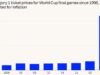
Sony Sports acquired the commercial rights to the 2014, 2018 and Euro 2016 FIFA World Cup for approximately $90 million in 2013, which would be almost double the current value when adjusted for inflation.
Eight years later, Reliance picked up the rights to the 2022 World Cup for $60 million.
FIFA had last year offered the rights for the next two World Cups as a package to the Indian market for $100 million. However, due to a lack of interest, the global football body has reconsidered the valuation to $35 million.
Even then, interest failed to materialize, exposing the broken economics of World Cup broadcasting in this part of the world.
“In India, the picture appears more nuanced than a simple lack of takers. Broadcasters are likely weighing a combination of structural and commercial considerations,” said Rohit Potphode, Managing Partner – Sports, Gaming, eSports & Live Experiences, Dentsu India.
Rohit Potphode discussed why the company wanted to apply for broadcast rights in Japan and not India for the 2026 FIFA World Cup. | Photo credit: special arrangement
Rohit Potphode discussed why the company wanted to apply for broadcast rights in Japan and not India for the 2026 FIFA World Cup. | Photo credit: special arrangement
Dentsu is the commercial partner for the 2026 FIFA World Cup in Japan, which was also among the top viewers of the tournament in 2022.
“Japan differs significantly from India in terms of audience appetite, advertisers and the overall media ecosystem.”
«A key factor is the timing of the matches; matches scheduled late at night or in the early morning hours for the Indian audience can have a significant impact on viewership peaks, which in turn impacts advertising inventory and revenue potential. Even major events can struggle to deliver optimal returns if they fall outside key viewing windows,» he adds.
The 2026 FIFA World Cup will be played in the United States of America, Canada and Mexico, making most of the matches outside of prime Indian viewing hours.
Of the 104 matches at the World Cup, only 14 will start before midnight this time. By comparison, Qatar 2022 had 44 of 64 matches before midnight, while Russia 2018 had 63.
Profitability the only priority
“The business scenario in sports in India has mainly shifted towards profitability,” said a source from one of the broadcasters.
«Subscribing is a limited option in this country, despite the appetite. In the West, football is largely behind paywalls. In India you can’t do that.»
Sky Sports charges a subscription fee of around £22 per month to broadcast the Premier League in Britain, while FOX Sports, the World Cup broadcaster in the US, sells its FOX One + ESPN bundle for $40 per month.
The 2022 FIFA World Cup was streamed on JioCinema and Sports18HD, with the former offering it for free and the latter charging Rs. 12 for the channel.
The result: India suffered one of the steepest individual market declines, losing 87 million linear viewers in four years. The public moved to digital, which was free, not away from football. Meanwhile, JioStar has reportedly lost millions on the free-to-air service.
However, overall, the number of football viewers in the country has decreased. The Indian Super League, the top of men’s football, saw the valuation of broadcast rights fall by 97 percent in the past year.
The World Cup has followed the same trend: during the 2022 edition, each match was worth Rs. 6.94 million. Four years later, that value has fallen to Rs. 1.56 crore per match – a decline of 77.5 per cent.
Most fans in India watched the 2022 World Cup for free on JioCinema, not on linear television. | Photo credit: Getty Images
Most fans in India watched the 2022 World Cup for free on JioCinema, not on linear television. | Photo credit: Getty Images
«The lack of advertising options in football is another problem. While commercial partners may have ad space after every over or dismissal in cricket, or perhaps after every set in tennis, in football this is largely limited to pre-match, half-time and full-time, with limited additional breaks,» said another person from an Indian broadcaster.
Potphode adds further insight. “The advertising market remains highly value-conscious, with brands increasingly looking for measurable and consistent returns across both television and digital platforms.
“With a packed sporting calendar and the continued rise in on-demand consumption, rights holders and broadcasters are likely to adopt a more calibrated approach, evaluating not just the scale, but also the quality and timing of audience engagement.”
Will there be a solution?
FIFA is expected to hold negotiations with leading Indian broadcasters – JioStar, FanCode, Sony Sports and ZEE Entertainment – looking for a final solution. DAZN is unlikely to join the conversation, while Netflix and YouTube have chosen not to comment.
If all options fail, the World Cup could return to Doordarshan, India’s public broadcaster, after 28 years. As per the Sports Broadcasting Signals (Mandatory Sharing with Prasar Bharati) Act, sporting events of national importance must be shared with the broadcaster.
Prasar Bharati, the parent company of Doordarshan, had made a profit of Rs. 3.5 crore of 1998 dues. | Photo credit: The Hindu Photo Library
Prasar Bharati, the parent company of Doordarshan, had made a profit of Rs. 3.5 crore of 1998 dues. | Photo credit: The Hindu Photo Library
That could provide a lifeline, with big matches – likely the knockouts and the final – telecast on Doordarshan, regardless of the primary rights holder.
Prasar Bharati, the parent company of Doordarshan, had made a profit of Rs. 3.5 crore from the 1998 rights. A return to public broadcasting could yet make the World Cup viable in India.
Published on April 22, 2026

:max_bytes(150000):strip_icc():format(jpeg)/98-yr-old-push-ups-2-062926-6a6c4dd486b94c0dbc26a4120d0e2d67.jpg?w=238&resize=238,178&ssl=1 "Un hombre de 98 años dice que hace 40 flexiones al día, yoga y Pilates después de adquirir el hábito más adelante en la vida: «Úsalo o piérdelo»")



:max_bytes(150000):strip_icc():format(jpeg)/98-yr-old-push-ups-2-062926-6a6c4dd486b94c0dbc26a4120d0e2d67.jpg?w=100&resize=100,75&ssl=1 "Un hombre de 98 años dice que hace 40 flexiones al día, yoga y Pilates después de adquirir el hábito más adelante en la vida: «Úsalo o piérdelo»")